The Language of the Sea
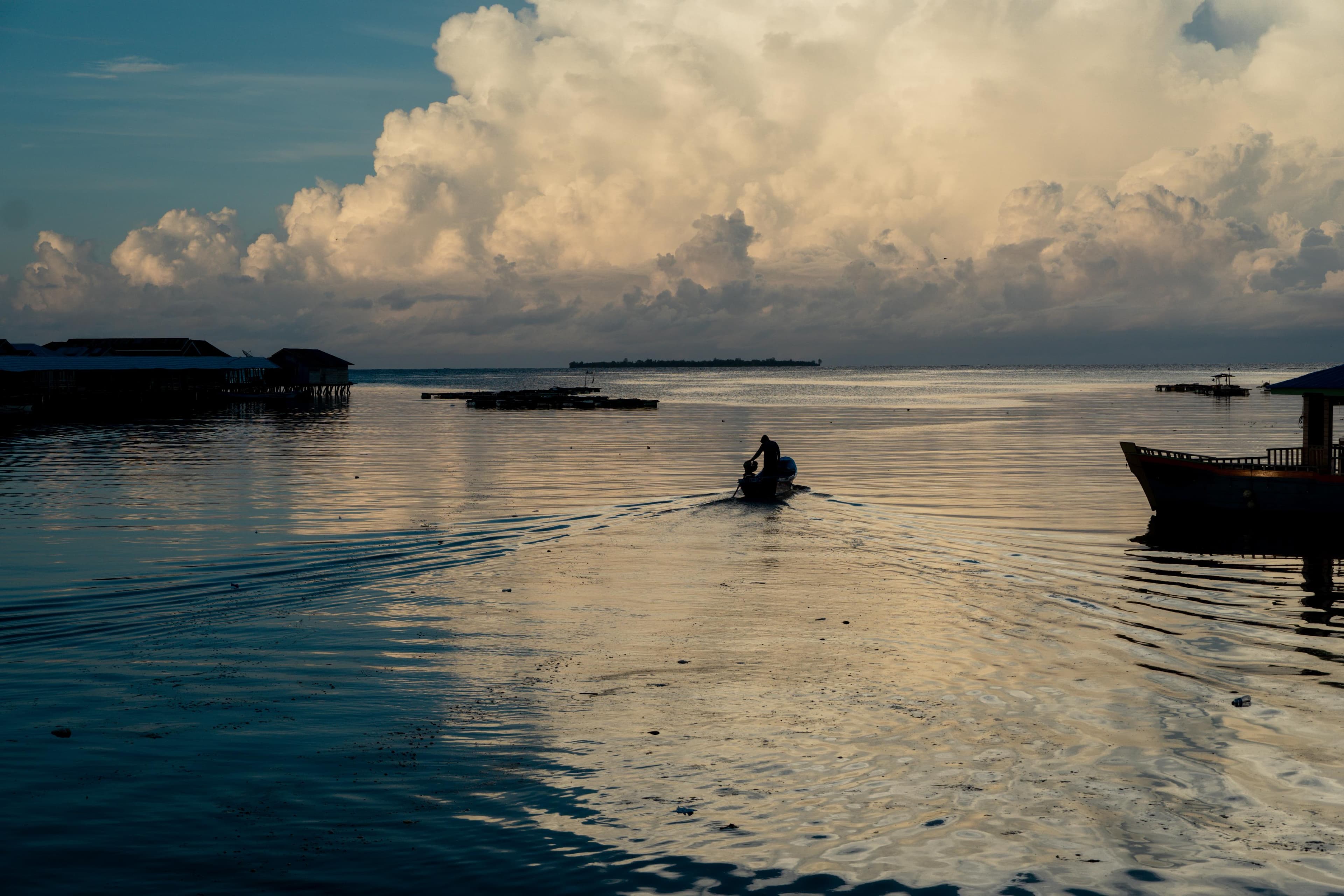
SINAR Institute, Torosiaje field visit, 2026
The sky over Torosiaje rarely stays quiet. In the early hours, immense clouds build on the horizon, catching the pale gold of the morning light before the heavy heat settles over the sea. Against this massive canvas of sky and water, a single wooden boat cuts a gentle wake. The silhouette of the fisherman leaning into the engine tells a story older than any formal record. He is leaving the intricate network of wooden stilt houses behind, heading out into the vast expanse where the water turns a deeper shade of indigo. To anyone watching from the mainland shore, it is just a man going to work. But out here, the definition of work involves a profound and intimate negotiation with the ocean.
For this fisherman, who also spends hours diving beneath the surface, the most crucial tool he possesses is not a net or a motor. It is his ability to read the subtle language of the water. To an untrained observer, the ocean is just a flat expanse of blue and grey. To him, a slight change in the surface tension or a momentary shift in the color of the waves reveals exactly what lies beneath. He can spot the invisible edge of a coral reef just by watching how the current breaks on the surface. This deeply ingrained knowledge is a matter of absolute survival. It dictates where he drops his line, when he decides to dive, and precisely when he knows it is time to turn the boat around before a hidden storm arrives.
When he slips over the side of the wooden hull and enters the water, the chaotic sounds of the surface disappear entirely. Down there in the muted blue, he does not rely on sophisticated equipment. He relies entirely on his lung capacity, his physical endurance, and his finely tuned instincts. He knows the exact topography of the seabed because his hands have mapped the coral structures over decades. He understands the seasonal movements of the fish, the sudden temperature changes in the deep currents, and the fragile balance of the entire marine ecosystem. The ocean is not just a resource to him. It is a direct extension of his own home. He moves through the underwater world with a quiet dignity, knowing that every breath he holds is a testament to the resilience of his people.
This daily journey is the absolute lifeblood of Torosiaje. When the outline of his boat finally reappears on the horizon later in the day, moving back toward the cluster of homes suspended miraculously above the sea, it brings more than just the day's catch. It brings a sense of continuity. The women waiting on the wooden platforms, the children learning to swim before they can properly walk, the elders mending broken nets in the narrow patches of shade, they are all deeply connected to the solitary figure steering the boat. Their entire social fabric is woven tightly around these daily departures and returns. The ocean shapes their diet, their economy, their architecture, and their shared identity.
When we talk about understanding the health and human development of geographically isolated populations, this is the exact reality we must start with. A conventional questionnaire cannot adequately capture the immense physical toll of holding your breath deep underwater for hours every day. A standard spreadsheet struggles to quantify the complex mental map a diver uses to navigate the open ocean without a compass. Often, when formal institutions arrive to study places like Torosiaje, they bring predetermined assumptions. They look at the community through the narrow lens of what is lacking. They see the distance to a mainland hospital or the absence of paved roads. But they entirely fail to see the incredible expertise sitting right there in the wooden boat.
The fisherman reading the ripples on the water is practicing his own highly rigorous form of science. He is making careful observations, testing hypotheses about the shifting weather, and adapting his methods based on generations of inherited evidence. This is exactly why we must recognize that communities hold vital lived experience and act as active contributors to knowledge. If we want to build a true understanding of a coastal environment, we cannot treat the people who live there as passive subjects waiting for outside intervention. We must treat them as the foremost experts of their own geography. We have to start listening to the reality of their environment before we ever begin measuring its outcomes.
True equity begins with a foundation of genuine respect. It begins by looking at the lone boat returning under the heavy clouds and acknowledging the incredible agency of the person steering it. It requires understanding that health cannot be separated from the geography, livelihood, and culture that shape a daily existence. The simplest things, like knowing exactly how the tide pulls against the wooden stilts of a house or reading the wind on the water, carry the most profound weight. Behind every single data point is a living, breathing life. And in Torosiaje, that life is intimately bound to the rhythm of the sea, moving steadily forward, one wave at a time.